Alastair Power, Investment Research Manager
Read this month’s Insight article to find out:
- How are government bond yields changing?
- Do gilts still hold attraction?
- Why are higher yields important for investors?
4 min read
Bond markets are back in the headlines, bringing negative sentiment and increased discussion.
Yields on 10-year
government bonds have returned to levels not seen since the 2008 financial crisis in both the UK and US while, in Japan, 10-year government bonds revisit yield levels last tested in the mid-1990s.
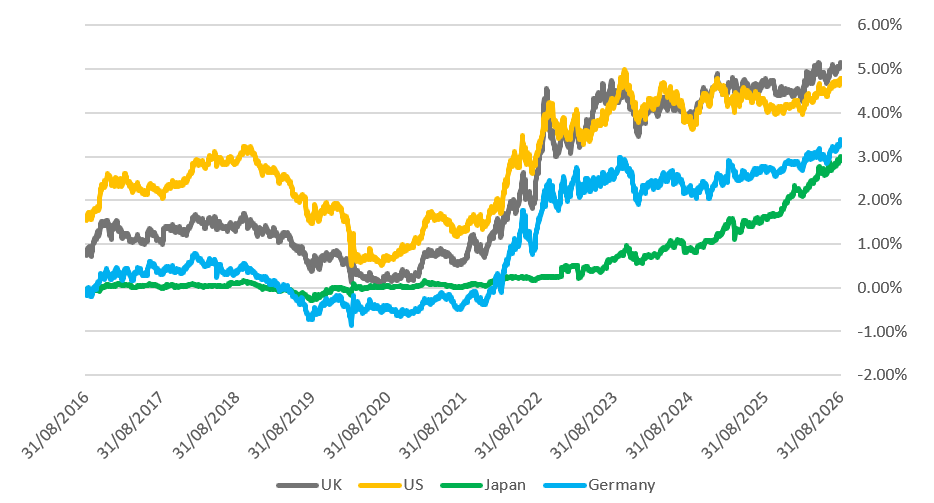
(Source: Factset)
Why are yields on the rise?
Yield increases have been driven by a several factors, from inflationary concerns resulting from re-escalations between the US and Iran, to government fiscal outlooks. In June, we covered inflation-linked gilts in greater detail. You can
read that article here.
While the trend of inflation rates has been downwards, conflict re-escalations on the Strait of Hormuz have caused upward pressure on energy prices and shorter-term volatility in inflation data. With the conflict duration extending beyond initial expectations, central bankers recently hinted at increased willingness to raise interest rates, causing shorter-dated government bond yields to move higher in response. On Wednesday 16
th September, the US Federal Reserve increased its interest rate for the first time in three years, while a day later, the Bank of England held its rate at 3.75%.
Bloated balance sheets of major developed governments, built in the aftermath of the 2008 financial crisis, continue to cause concern. Government debt levels as a proportion of gross domestic product (GDP), the total value of goods and services produced within an economy, vary from 94.1% in the UK, to 122.6% in the US and 198.6% in Japan. Longer-dated yields have moved higher, reflecting concerns around the delicate balancing act between debt management and spending requirements across many developed economies.
Do gilts still hold attraction?
Starting yields are widely considered one of the most reliable predictors of forward-looking returns, provided the bonds are held to
maturity. Higher yields, therefore, offer the opportunity to lock-in attractive returns across a range of timescales. Which bonds to buy depends on individual circumstances, including time horizon, income requirements, and tax considerations.
Previously issued low-coupon bonds that are trading at prices below face value could offer tax efficiency as there could be exemptions from Capital Gains Tax. However, tax rules and how they apply to individuals can vary and do change from time to time. The Financial Conduct Authority does not regulate tax or estate planning.

(Source: Factset)
Why are higher yields important for investors?
Overall, despite the rise in yields causing negative sentiment linked to their effects on government borrowing costs and inflation, UK government bonds continue to hold attraction. High levels of liquidity, yields in excess of inflation, and a wide variety of maturities and coupon profiles enables significant flexibility to tailor allocations to the asset class to individual requirements. As such, they are expected to remain a useful allocation across a broad range of portfolios.
Higher yields provide more income focused opportunities. Recently issued UK government bonds show
coupons in the 4.0% to 5.0% range, benefitting investors looking for stable income.
The total value of annuity premiums paid has risen to the highest levels since the announcement of pension freedoms in 2014. We would always recommend consulting a financial planner for wealth planning advice when choosing an annuity.
If you would like to discuss your investments or your investment options, or discuss financial planning,
please contact your usual Redmayne Bentley executive or office.
Please note that this communication is for information only and does not constitute a recommendation to buy or sell the shares of the investments mentioned. Investments and income arising from them can fall as well as rise in value. Past performance and forecasts are not reliable indicators of future results and performance. The information and views were correct at time of publication but may have changed at the point of reading.